
It is the question every health-conscious Indian family eventually asks: should we give up rice for millets? The honest answer is more balanced and more practical than the internet usually suggests.
The core difference
Most rice we eat is polished, which strips away the fibre-rich bran and nutrient-dense germ, leaving mainly starch. Millets, when minimally processed, are eaten closer to whole, keeping that fibre and those minerals.
That single difference — whole versus refined — explains most of the nutritional gap between the two.
Where millets pull ahead
Whole millets generally carry more fibre than polished rice, which supports fullness, gut health and a gentler rise in blood sugar after meals.
Different millets also bring specific minerals — calcium from ragi, iron from bajra — adding variety that a single grain cannot match.
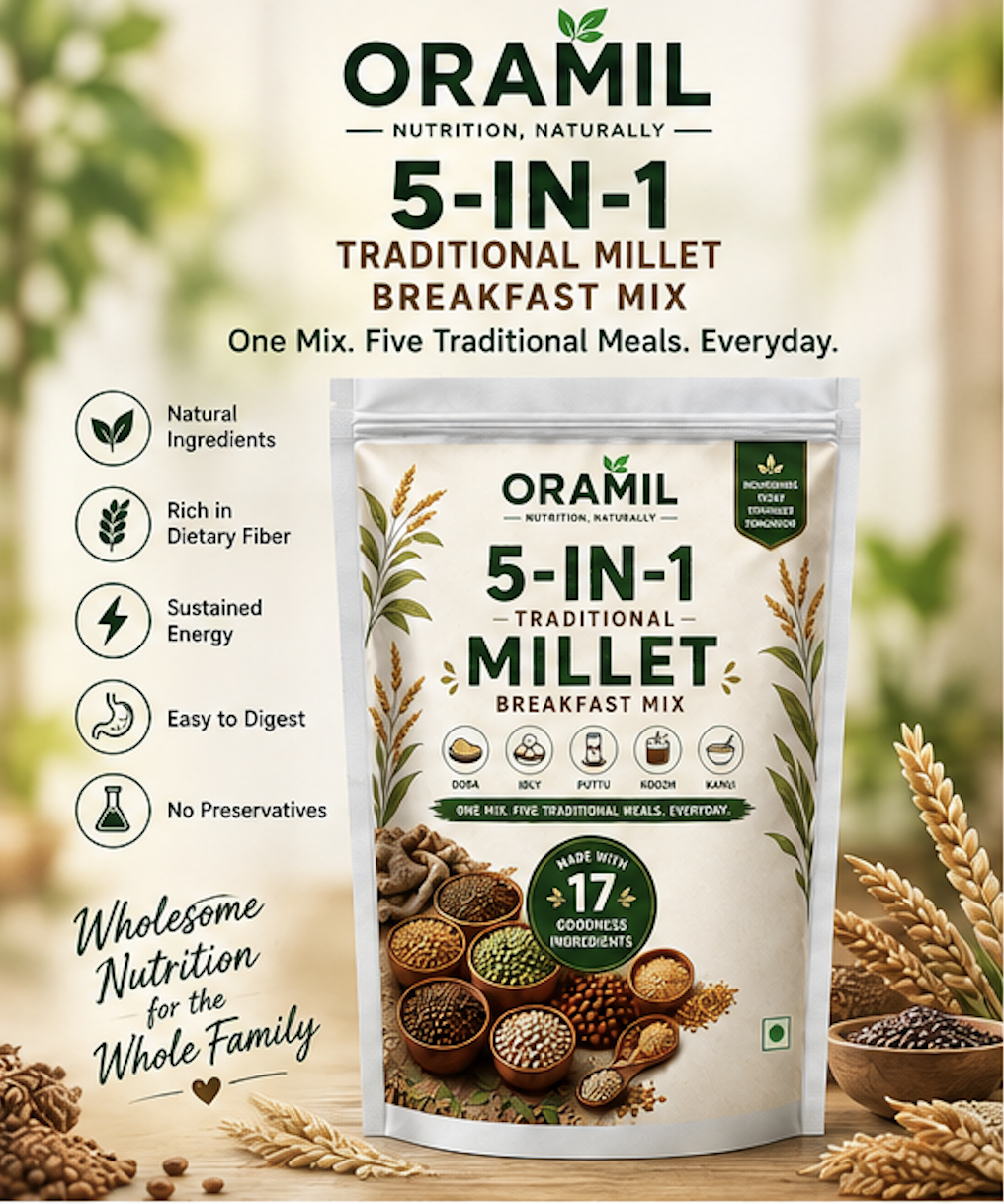
ORAMIL 5-in-1 Millet Mix
17 traditional millets, grains, pulses and seeds in one mix — make Dosa, Idly, Puttu, Koozh and Kanji from a single pack, no preservatives.
Explore 5-in-1 Millet MixWhere rice still fits
Rice is not poison. It is easy to digest, universally loved, and a comforting base for countless dishes. For many families, the goal is not to banish rice but to stop relying on it for every single meal.
Replacing even a few rice meals a week with millets is a meaningful upgrade without any sense of deprivation.
The sensible middle path
The most sustainable approach is to rotate. Keep the rice dishes you love, and work millets into breakfast and a few other meals through the week.
A traditional millet breakfast mix makes this effortless: you make dosa, idly or porridge from millets in the morning and keep the rest of your day as it is.
What matters most
Whichever grain is on the plate, the rest of the meal matters too — vegetables, dals, how much oil and sugar, and overall portion. Millets help, but they are one part of a balanced diet.
Think of millets as a steady, sensible addition to your family's grains, not a miracle replacement.
Frequently asked questions
Should I stop eating rice completely?
There is usually no need. Most families do best by keeping some rice and rotating in millets for breakfast and a few meals, rather than giving up rice entirely.
Are millets better than rice for blood sugar?
Whole millets are higher in fibre and tend to raise blood sugar more gently than polished rice, which is why they are often suggested for people managing blood sugar, under medical guidance.
Can I mix millets and rice in one meal?
Yes, blending millets with rice is a gentle way to increase fibre while keeping a familiar taste and texture, and it is a great way to start.
ORAMIL 5-in-1 Millet Mix
17 traditional millets, grains, pulses and seeds in one mix — make Dosa, Idly, Puttu, Koozh and Kanji from a single pack, no preservatives.
Explore 5-in-1 Millet MixKeep reading: ragi (finger millet): benefits, nutrition and how to use it, bajra (pearl millet): benefits and everyday uses, and jowar (sorghum): the versatile everyday millet.